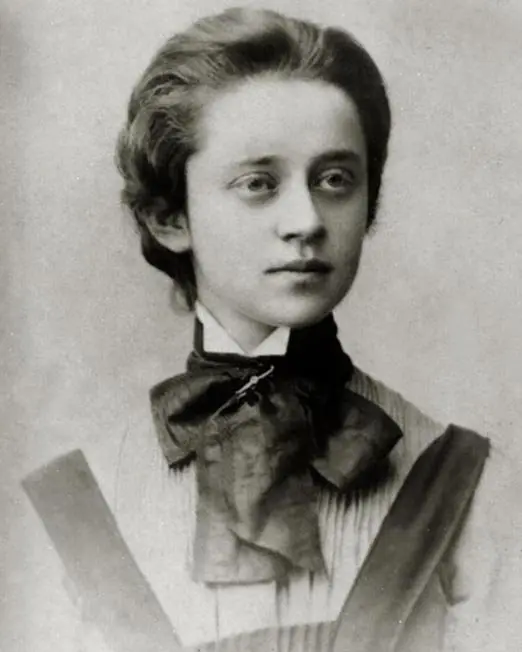
- Born
- 11 August 1885Taganrog, Russia
- Died
- 26 August 1933Karinskoye, Russia · aged 48
Sophia Parnok
“Russia’s Sappho” wrote openly about love between women – and had an intense affair with the poet Marina Tsvetaeva.
Sophia Parnok grew up in a well-off Jewish family in Taganrog on the Sea of Azov. Her mother died when she was a child. From an early age she wrote poetry and knew that she loved women. She studied briefly in Geneva and then lived in Moscow and Saint Petersburg. (Her date of birth is given in the Gregorian calendar.)
She worked as a literary critic under the male pseudonym Andrei Polianin and as a translator. In 1914 she met the young poet Marina Tsvetaeva; their passionate affair lasted almost two years and inspired Tsvetaeva’s poem cycle “Girlfriend”.
Parnok published several volumes of poetry in which she wrote openly and without disguise about her love for women, something almost unique in Russian literature of the time. She was called “Russia’s Sappho”. After the revolution she lived in Moscow in poverty, increasingly unable to publish her work, and wrote libretti for operas to earn a living.
In her last years she lived with the mathematician Olga Tsuberbiller and fell in love with the physicist Nina Vedeneyeva, to whom she dedicated some of her finest late poems. She died of heart disease in a village near Moscow in 1933, aged 48.