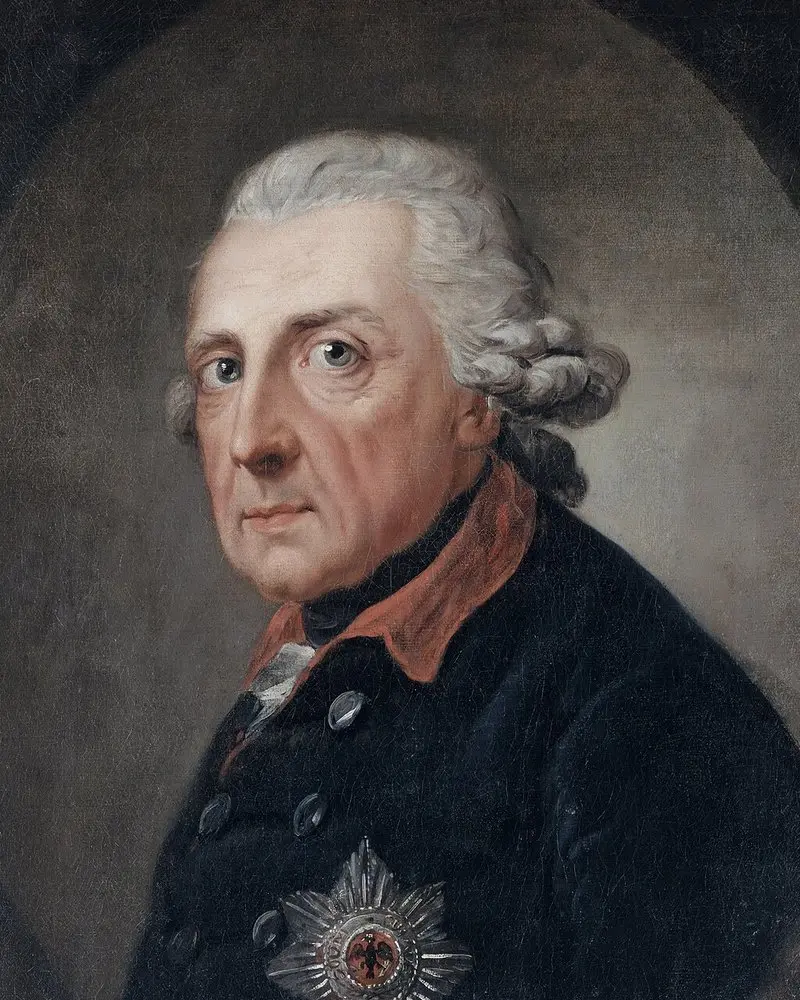
- Born
- 24 January 1712Berlin, Prussia
- Died
- 17 August 1786Potsdam, Prussia · aged 74
Frederick the Great
A Prussian king whose military ambitions and intellectual life sit beside a much-debated private history.
Frederick II of Prussia was born in Berlin in 1712. His father, Frederick William I, treated his interest in music and French culture with contempt. After Frederick attempted to escape abroad in 1730, his father ordered the execution of his close companion Hans Hermann von Katte.
Frederick became king in 1740 and seized Silesia from Austria, beginning a series of wars that helped make Prussia a major European power. His reputation as an enlightened ruler rested alongside the human cost of those ambitions. He corresponded with Voltaire, composed music and built Sanssouci at Potsdam.
His marriage to Elisabeth Christine in 1733 produced no children, and the couple largely lived apart. Letters, contemporary accounts and his close attachments to men have led many historians to understand him as a man who desired men. The evidence does not allow every rumour to be treated as fact, and the meaning of intimacy differed from modern identity categories.
Frederick died at Sanssouci in 1786, aged 74. His wish to be buried beside his dogs on the palace terrace was fulfilled only in 1991.