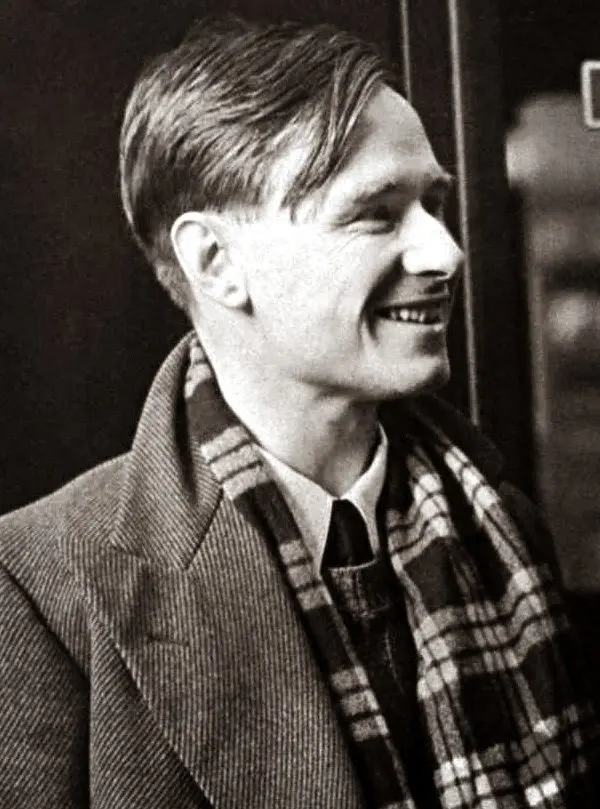
- Born
- 26 August 1904High Lane, Cheshire, England
- Died
- 4 January 1986Santa Monica, California, USA · aged 81
Christopher Isherwood
His Berlin stories helped inspire “Cabaret”; later writing made his own gay life and relationships explicit.
Christopher Isherwood was born in High Lane, Cheshire, in 1904. Raised in a privileged English family, he found a different kind of freedom in Berlin, where he moved in 1929 and remained until 1933.
“Mr Norris Changes Trains” (1935) and “Goodbye to Berlin” (1939) drew on those years, observing lives lived against the rise of Nazism. “Goodbye to Berlin” became a principal source for the play “I Am a Camera” and, through later adaptations, the musical and film “Cabaret”.
Isherwood emigrated to the United States in 1939, worked in Hollywood and became closely involved with Vedanta. His novel “A Single Man” (1964) follows a gay professor through a day shaped by grief. In “Christopher and His Kind” (1976), he revisited his earlier writing and spoke more directly about the sexual life it had partly concealed.
He met the painter Don Bachardy in 1953, beginning a relationship that lasted until Isherwood’s death in 1986. His later books and diaries brought private experience into conversation with the changing public possibilities for gay men.