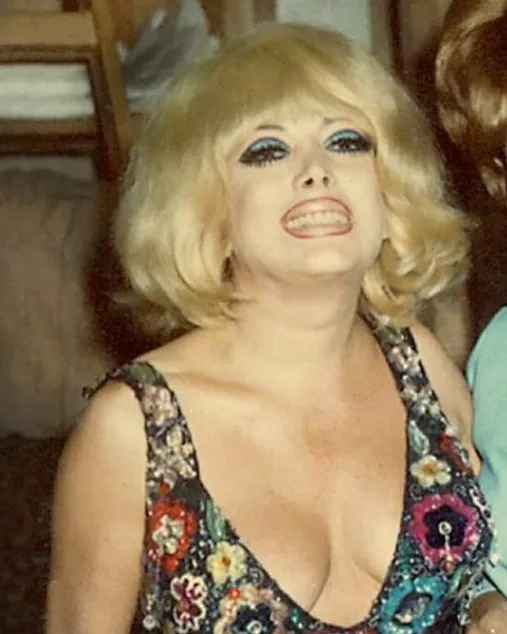
- Born
- 23 August 1931Paris, France
- Died
- 9 October 2006Marseille, France · aged 75
Coccinelle
France’s first trans icon fought for the right to change her civil status – and her church wedding paved the way for trans people’s right to marry.
Coccinelle was born Jacqueline Charlotte Dufresnoy in Paris and assigned male at birth. Her mother sold flowers in Pigalle. As a teenager she began going out in women’s clothes; her stage name, French for “ladybird”, is said to come from a red dress with black spots. In 1953 she first appeared at the Paris cabaret Madame Arthur and later at the Carrousel de Paris, where many trans performers worked – at a time when the police could still harass them for “cross-dressing”.
In 1958 she underwent gender-affirming surgery with the doctor Georges Burou in Casablanca, as one of the first famous women in Europe to do so. The news went round the world, and Coccinelle became a star, styled as a blonde sex symbol. She appeared in films and in 1963 headlined a revue at the Paris Olympia.
With the help of the lawyer Robert Badinter – who later, as Minister of Justice, decriminalised homosexuality in France – she obtained a change of her civil status. In 1962 she married the journalist Francis Bonnet, at the town hall and in church, after being baptised again. It was the first marriage of a trans person officially recognised in France.
Coccinelle toured Europe and Latin America for decades. She founded the association “Devenir Femme” to support trans people undergoing surgery and helped set up a centre for counselling and research on trans identity. She died in Marseille in 2006, aged 75.