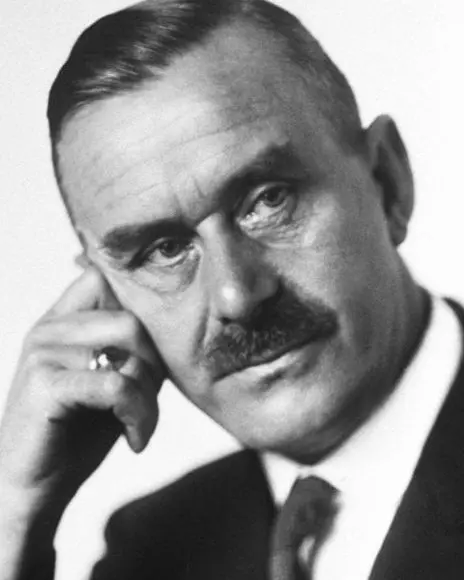
- Born
- 6 June 1875Lübeck, Germany
- Died
- 12 August 1955Zurich, Switzerland · aged 80
Thomas Mann
The Nobel laureate of “Buddenbrooks” and “Death in Venice” was a married father of six – and his diaries reveal a lifelong desire for men.
Thomas Mann grew up in Lübeck in a wealthy merchant family, whose decline he described in his first novel, “Buddenbrooks” (1901). It made him famous and won him the Nobel Prize in Literature in 1929. In 1905 he married Katia Pringsheim, with whom he had six children, among them Erika, Klaus and Golo Mann.
His work often deals with artists, outsiders and forbidden desire. In “Death in Venice” (1912) an ageing writer falls helplessly in love with a beautiful Polish boy. Further major works followed: “The Magic Mountain” (1924), the tetralogy “Joseph and His Brothers” and “Doctor Faustus” (1947).
His diaries, which he ordered not to be opened until twenty years after his death, revealed that Mann had been attracted to men all his life. As a young man he loved the painter Paul Ehrenberg; in 1927 he fell for the 17-year-old Klaus Heuser, and in old age for a young waiter in Zurich. As far as is known, he never acted on these feelings, but they shaped his writing.
In 1933 he went into exile, first in Switzerland, then in the United States, where he campaigned against Hitler in radio broadcasts. He returned to Switzerland in 1952 and died in Zurich in 1955, aged 80.