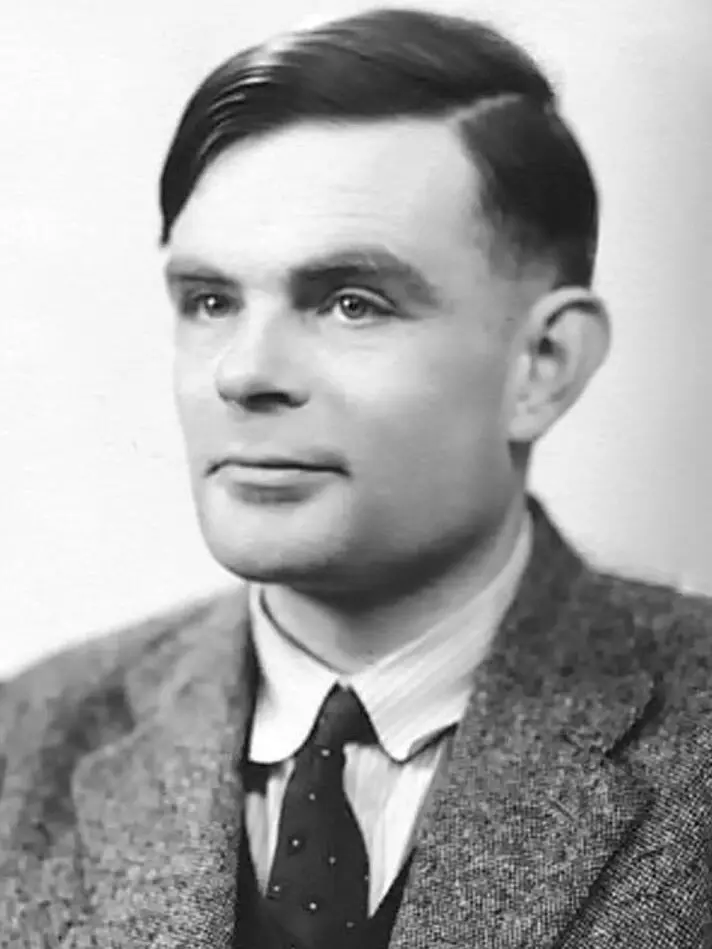
- Born
- 23 June 1912London, England
- Died
- 7 June 1954Wilmslow, England · aged 41
Alan Turing
His ideas helped make modern computing possible. His work on Enigma served Britain during the war; in 1952, Britain prosecuted him for a relationship with another man.
Alan Mathison Turing was born in London in 1912. In 1936, he published a paper describing an imaginary machine that could follow a set of precise instructions. A universal version could simulate any machine of this kind. It was a mathematical idea with far-reaching consequences, laying foundations for computer science.
During the Second World War, Turing worked at Bletchley Park, Britain's codebreaking centre. He played a leading role in deciphering German naval Enigma messages and devised the British bombe, a machine that searched for possible Enigma settings. Gordon Welchman made a crucial improvement to its design. Their work built on earlier Polish breakthroughs and formed part of a much larger codebreaking effort.
After the war, Turing designed the Automatic Computing Engine, an early stored-program computer. His 1950 paper on machine intelligence proposed the “imitation game”, now known as the Turing test.
In 1952, he was convicted of “gross indecency” for a sexual relationship with another man. Rather than go to prison, he accepted probation that required hormone treatment, commonly described as chemical castration. He also lost his security clearance. He died of cyanide poisoning in 1954; the inquest ruled his death a suicide.
The British government apologised for his treatment in 2009, and he received a royal pardon in 2013. Provisions known as the “Alan Turing law” extended pardons to other men in England and Wales in 2017, subject to legal conditions. His portrait has appeared on the Bank of England's £50 note since 2021.