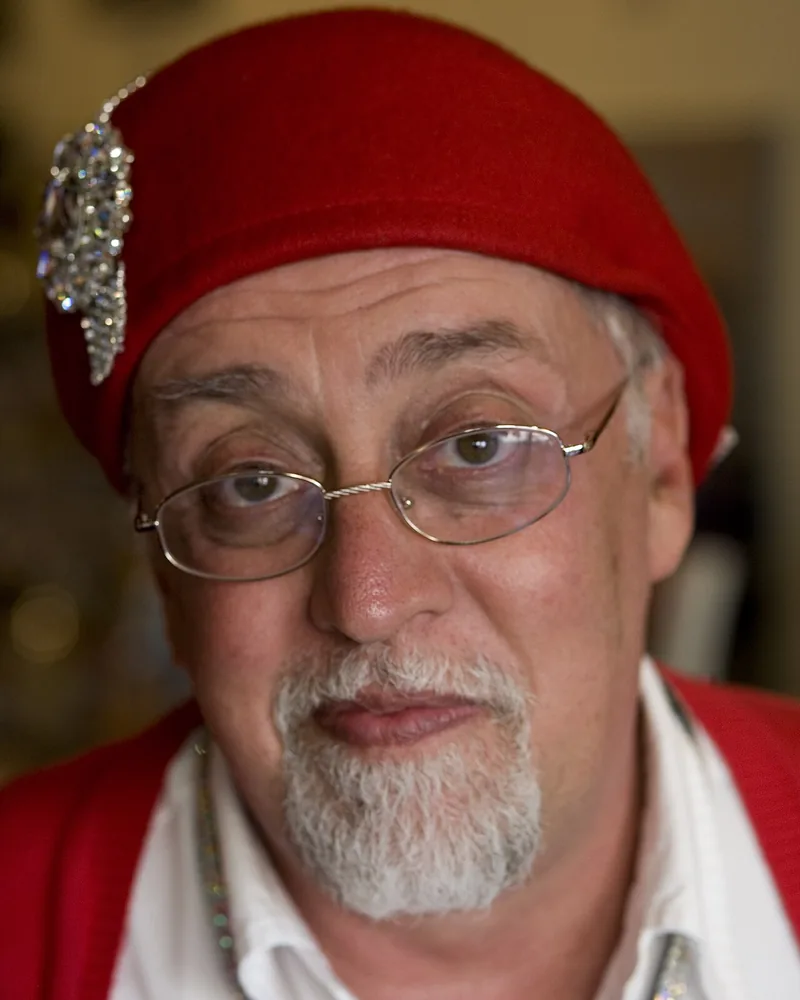
- Born
- 2 June 1951Chanute, Kansas, USA
- Died
- 31 March 2017New York City, USA · aged 65
Gilbert Baker
He dyed and sewed the first rainbow flags by hand – and refused to trademark them, because the flag belonged to everyone.
Gilbert Baker grew up in Parsons, Kansas, where his grandmother ran a women’s clothing shop. From 1970 to 1972 he served in the US Army as a medic in San Francisco, just as the gay rights movement was taking shape there. He stayed in the city, taught himself to sew and made banners for gay rights and anti-war marches. He became friends with Harvey Milk and often performed in drag.
In 1978 Milk and other activists asked for a new, positive symbol for the community – one to replace the pink triangle the Nazis had used to mark homosexual men. With around thirty volunteers, Baker hand-dyed and sewed two huge flags with eight coloured stripes. On 25 June 1978 they flew for the first time at San Francisco’s Gay Freedom Day Parade. Each colour had a meaning, from pink for sexuality to violet for spirit.
After Milk’s murder in November 1978, demand for the flag soared. For mass production, the pink and turquoise stripes were dropped; the six-stripe version went round the world. Baker deliberately never trademarked his design. He worked for a flag company in San Francisco, later moved to New York and made ever larger rainbow flags, including one stretching more than a mile across Key West in 2003.
Baker died in his sleep in New York in 2017, aged 65. The Museum of Modern Art in New York added the rainbow flag to its collection.