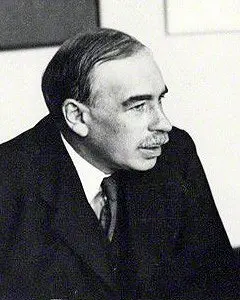
- Born
- 5 June 1883Cambridge, England
- Died
- 21 April 1946Firle, England · aged 62
John Maynard Keynes
The most influential economist of the 20th century had relationships with men for years – before he married a Russian ballerina.
John Maynard Keynes grew up in Cambridge, the son of an economist and a social reformer who later became mayor of the city. He studied mathematics at King’s College, Cambridge, and became part of the Bloomsbury Group, the circle around Virginia Woolf, Lytton Strachey and the painter Duncan Grant.
For many years Keynes’s relationships were with men; among his lovers was Duncan Grant. In 1925, to the surprise of his friends, he married the Russian ballerina Lydia Lopokova, and the marriage was a happy one until his death.
At the peace conference of 1919 Keynes warned that the harsh conditions imposed on Germany would lead to disaster; his book “The Economic Consequences of the Peace” made him famous. In his “General Theory of Employment, Interest and Money” (1936) he argued that governments must spend money in a crisis to overcome unemployment. His ideas shaped economic policy for decades.
At the Bretton Woods conference in 1944 he helped design the post-war international monetary system. Exhausted by negotiations, he died of a heart attack at his country house in Sussex in 1946, aged 62.