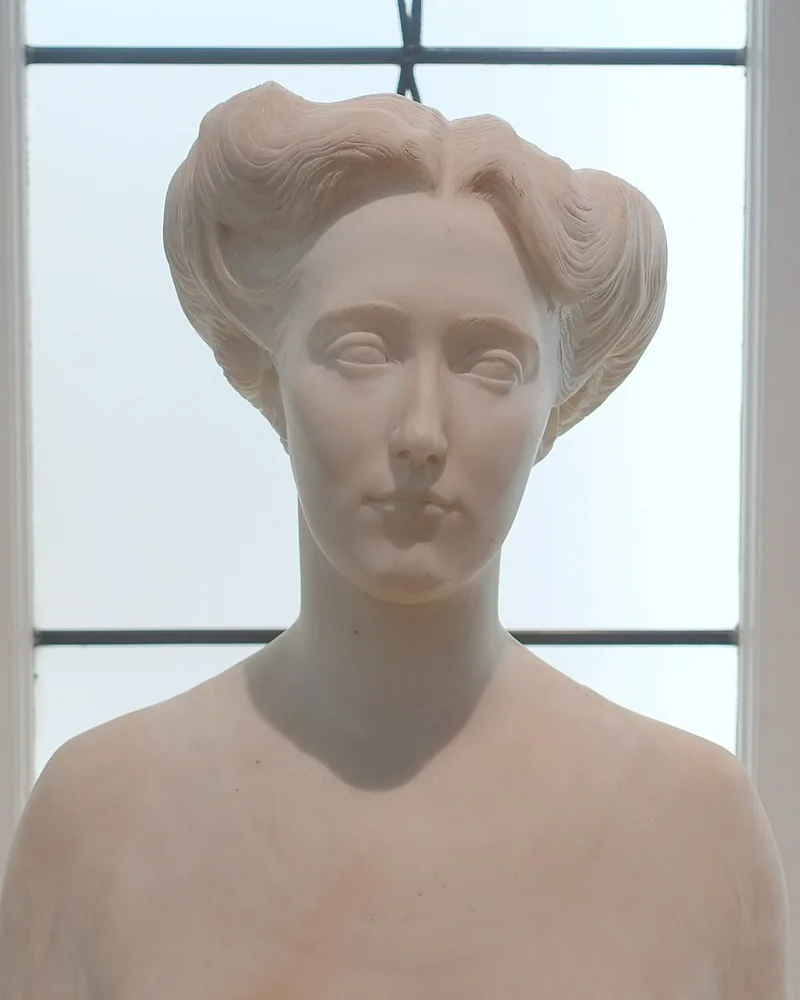
- Born
- 23 December 1888Darmstadt, Germany
- Died
- 10 June 1944Cluny, France · aged 55
Christa Winsloe
She wrote “Mädchen in Uniform”, one of the first films to portray love between women with sympathy – and was murdered with her partner in 1944.
Christa Winsloe was the daughter of an officer in Darmstadt. After her mother’s early death she was sent to the Kaiserin-Augusta-Stift in Potsdam, a strict boarding school for daughters of the aristocracy. These years never left her. Against her family’s wishes she studied sculpture in Munich and became known for her animal sculptures. In 1913 she married the Hungarian writer Baron Lajos Hatvany; the marriage failed.
In 1930 her play about a schoolgirl who falls in love with her teacher premiered in Leipzig and then in Berlin. A year later it was filmed as “Mädchen in Uniform” (Girls in Uniform), with an all-female cast and with Winsloe as co-writer. The film was shown throughout Europe, in the United States and in Japan and is regarded today as one of the first films to depict lesbian love with sympathy. In 1933 she published the story as a novel, “Das Mädchen Manuela”, in which the love between the two women is more explicit.
Winsloe lived openly with women. With the American journalist Dorothy Thompson, who warned early against Hitler, she went to the United States for a time. The Nazis put her books on the list of undesirable literature. She helped persecuted people to emigrate and finally settled in the south of France, where she lived with the Swiss writer Simone Gentet.
On 10 June 1944, near Cluny in Burgundy, four men shot the two women, falsely accusing them of being spies. The perpetrators were acquitted in 1948.