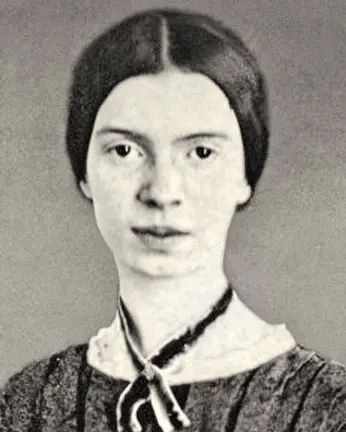
- Born
- 10 December 1830Amherst, Massachusetts, USA
- Died
- 15 May 1886Amherst, Massachusetts, USA · aged 55
Emily Dickinson
A poet whose private world opened into an extraordinary range of language, feeling and thought.
Emily Dickinson was born in Amherst, Massachusetts, in 1830. She wrote nearly eighteen hundred poems, exploring death, faith, nature and love through compressed language, unconventional punctuation and unexpected rhymes. Only a small number appeared in print during her lifetime, generally without her name.
In her later years she increasingly withdrew from public life. Yet her letters reveal a lively engagement with other people, and her seclusion should not obscure the relationships that sustained her writing.
Among the most important was Susan Gilbert, who married Dickinson’s brother Austin in 1856 and lived next door. Over decades Dickinson sent her hundreds of poems and letters. Susan was an attentive reader as well as the recipient of intensely affectionate writing.
Their relationship has been interpreted in different ways, including as a romantic love between women. The surviving correspondence supports its emotional and literary importance, while leaving questions that modern labels cannot fully resolve. After Dickinson died in 1886, her sister Lavinia helped bring the poems into print. Successive editions gradually revealed work that early editors had often altered to fit conventional expectations.