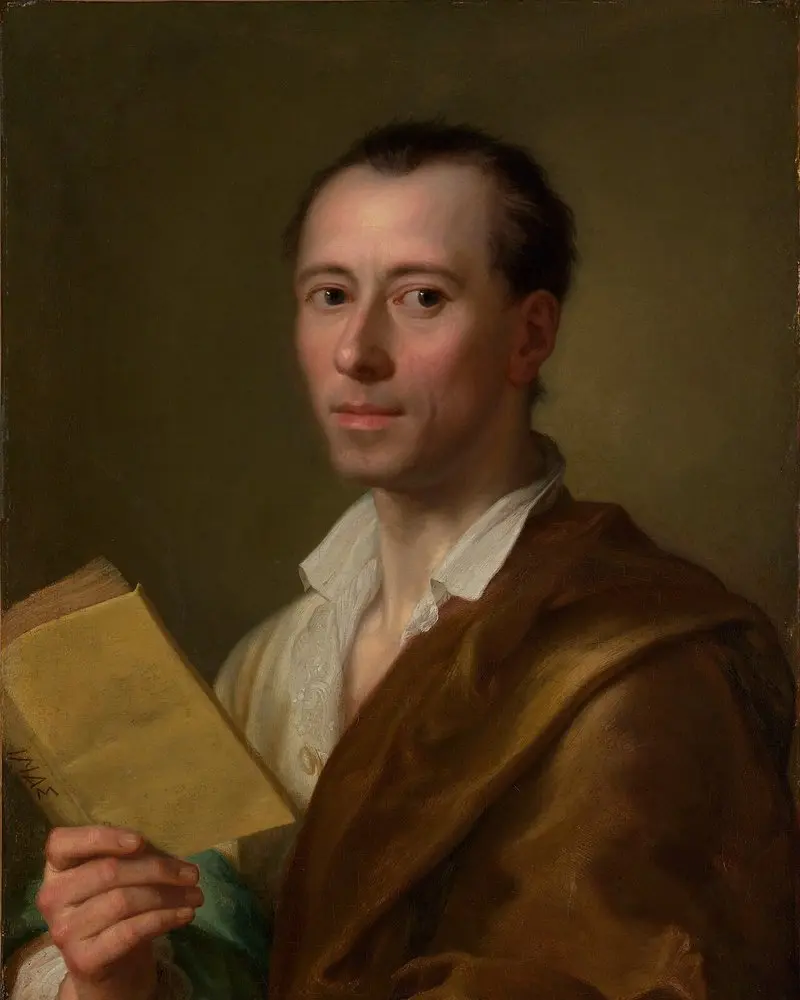
- Born
- 9 December 1717Stendal, Prussia
- Died
- 8 June 1768Trieste, Austria (today Italy) · aged 50
Johann Joachim Winckelmann
The founder of modern art history celebrated the beauty of Greek statues of young men – and wrote passionate letters to his male friends.
Johann Joachim Winckelmann was the son of a poor shoemaker in Stendal. Through great effort he studied theology and medicine and worked as a schoolteacher and librarian. His passion was Greek antiquity.
In 1755 he published “Thoughts on the Imitation of Greek Works”, in which he praised the “noble simplicity and quiet grandeur” of Greek art. The same year he converted to Catholicism in order to go to Rome, where he became librarian to Cardinal Albani and later superintendent of antiquities in Rome. His “History of the Art of Antiquity” (1764) founded art history as a discipline and inspired Neoclassicism across Europe, from Goethe to architecture and painting.
Winckelmann’s descriptions of male statues such as the Apollo Belvedere are full of erotic admiration. He had intense friendships with young men and wrote them passionate letters; scholars today see his life and work as an early expression of love between men, although the language of his time had no word for it.
In 1768, on his way back to Rome, he was robbed and stabbed to death in an inn in Trieste by a man he had met there. He was 50 years old.