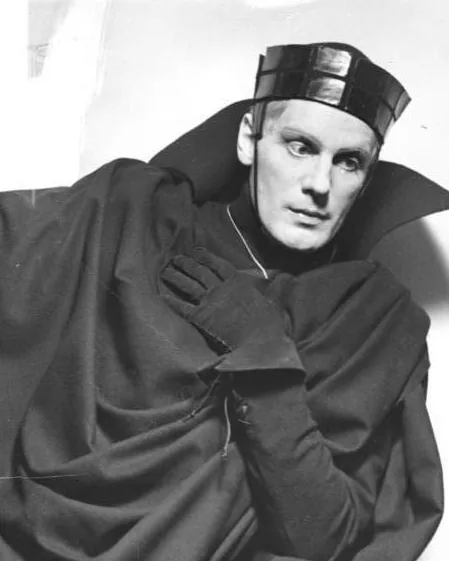
- Born
- 22 December 1899Düsseldorf, Germany
- Died
- 7 October 1963Manila, Philippines · aged 63
Gustaf Gründgens
Germany’s most famous Mephisto was widely known to love men – and was protected by Göring while other gay men were sent to camps.
Gustaf Gründgens trained as an actor in his hometown of Düsseldorf after the First World War. In Hamburg in 1925 he began a relationship with the writer Klaus Mann; in 1926 he married Mann’s sister Erika. The marriage ended a few years later. In Berlin he joined Max Reinhardt’s ensemble and played the gangster boss in Fritz Lang’s film “M” (1931). His most famous role was Mephisto in Goethe’s “Faust”.
After the Nazis came to power, his career continued. In 1934 he became director of the Prussian State Theatre, and Hermann Göring appointed him a Prussian State Councillor, a title that protected him from arrest. While other gay men were persecuted and sent to concentration camps, Gründgens was tolerated because of his fame. In 1936 he married the actress Marianne Hoppe. Whether he was an opportunist or used his position to protect colleagues is still debated; he did save the communist actor Ernst Busch from execution.
After the war he was held by the Soviet secret police for nine months. He then directed theatres in Düsseldorf and Hamburg, and his production of “Faust” was filmed in 1960.
Klaus Mann portrayed him in the novel “Mephisto” (1936) as an actor who sells his soul to the Nazis; after Gründgens’ death, his heir had the novel banned in West Germany. Gründgens died in Manila in 1963 during a trip around the world, after taking too many sleeping pills; whether it was intentional has never been established.