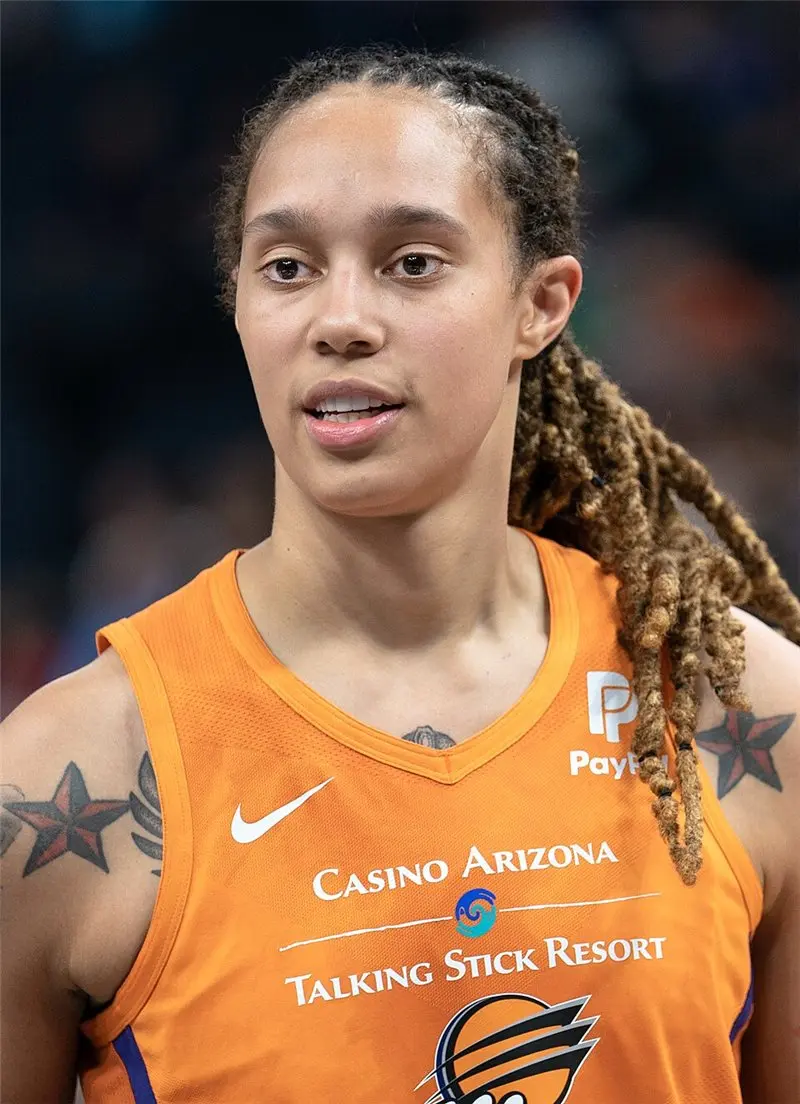
Brittney Griner
Brittney Griner built an exceptional basketball career through defence, scoring and international success. Her return after Russian detention also gave her a public role supporting Americans held abroad.
Brittney Griner was born in Houston, Texas, in 1990. Her height, shot-blocking and ability to dunk brought her national attention at Baylor University. Playing at centre, she developed a combination of reach, timing and skill that could change how opponents approached the basket.
The Phoenix Mercury selected her first in the 2013 WNBA draft. In her second season, she helped the team win the 2014 championship. Defensive Player of the Year awards in 2014 and 2015 recognised an influence that extended beyond the points she scored herself.
A successful shot-blocker can alter a game even when no block appears in the statistics. Opponents must decide whether to challenge the defender, change direction or pass. Griner's presence near the basket became one of the defining features of her professional career, alongside her development as a scorer.
In 2013 she also spoke openly about being gay and about the bullying she had experienced. She wanted young people facing similar treatment to know that they were not alone. Her visibility connected an elite sporting career with a discussion of how gender expectations shape the treatment of girls and women.
With the United States team, she won Olympic gold in Rio de Janeiro in 2016, at the delayed Tokyo Games in 2021 and in Paris in 2024. International basketball also formed part of her livelihood. Like other WNBA players, she spent off-seasons playing for clubs abroad.
In February 2022 she was arrested at a Moscow airport after cannabis oil was found in vape cartridges in her luggage. She was travelling to play for a Russian club. A court sentenced her to nine years in prison, and she was transferred to a penal colony.
Griner was released in December 2022 in a prisoner exchange after nearly ten months in detention. Her imprisonment had become an international political issue, but its consequences also involved separation from family and uncertainty about whether she would return to her profession.
She resumed professional basketball and campaigned for Americans detained abroad. Her memoir “Coming Home”, published in 2024, added her own account to a story that had previously been described largely through officials, court proceedings and news coverage. It followed the earlier memoir “In My Skin”.
After eleven seasons with Phoenix, she joined the Atlanta Dream in 2025 and signed with the Connecticut Sun in 2026. These moves continued a sporting life that had been interrupted rather than concluded by detention. Her record now combines championship basketball, public openness about sexuality and sustained attention to people still waiting to come home.