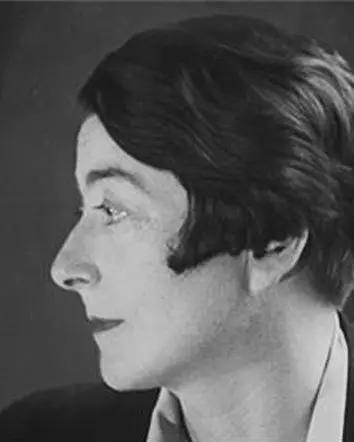
- Born
- 9 August 1878Enniscorthy, Ireland
- Died
- 31 October 1976Paris, France · aged 98
Eileen Gray
Her furniture and buildings made modern design attentive to movement, privacy and comfort, extending an exacting knowledge of materials into the spaces people inhabit.
Eileen Gray was born in Enniscorthy, Ireland, in 1878. She studied at the Slade School of Fine Art in London before making Paris the centre of her working life. There she developed an unusually wide practice, moving between lacquer, textiles, furniture, interiors and architecture.
Training with the Japanese craftsman Seizo Sugawara gave her a demanding knowledge of lacquer. The process required patience and close attention to surfaces. Her early furniture combined that technical discipline with forms that responded to the artistic experiments around her, making traditional craftsmanship part of a modern visual language.
In 1922 she opened the Galerie Jean Désert in Paris as an outlet for her designs. Furniture and rugs belonged to a broader conception of the interior, in which colour, texture and the placement of individual objects shaped the experience of a room. Her work initially served wealthy clients, but her interests increasingly reached beyond luxurious decoration.
During the 1920s she began using materials associated with modern industry, including tubular steel and glass. The adjustable E-1027 table became one of her best-known designs. Its changeable height answered a practical need, expressing an approach in which the object should accommodate a person’s habits rather than dictate them.
Without formal architectural training, Gray developed the seaside house E-1027 at Roquebrune-Cap-Martin with her partner, architect and critic Jean Badovici, between 1926 and 1929. Its name combines their initials. She considered the building, furnishings and fittings together, designing storage and movable elements that allowed a small space to support different activities.
Privacy mattered alongside openness. A modern house could welcome sunlight and views while allowing its occupants to remain independent of one another. Gray’s attention to that balance gives the building an intimacy easily missed in photographs of its white exterior. The interior was conceived around the practical and psychological needs of people living there.
Le Corbusier later painted murals inside the house without her approval, an intervention she opposed. The episode became part of a larger history in which her authorship received less attention than the famous men associated with the site. Her subsequent house, Tempe à Pailla at Castellar, gave her another opportunity to develop her architectural ideas.
Gray had relationships with men and women, including the singer Damia, while keeping much of her personal life private. Recognition of her work grew late in her life and expanded after her death in Paris on 31 October 1976. The surviving designs reward close attention: a hinge, a surface or a carefully placed shelf can reveal how thoroughly she imagined the act of living in a room.