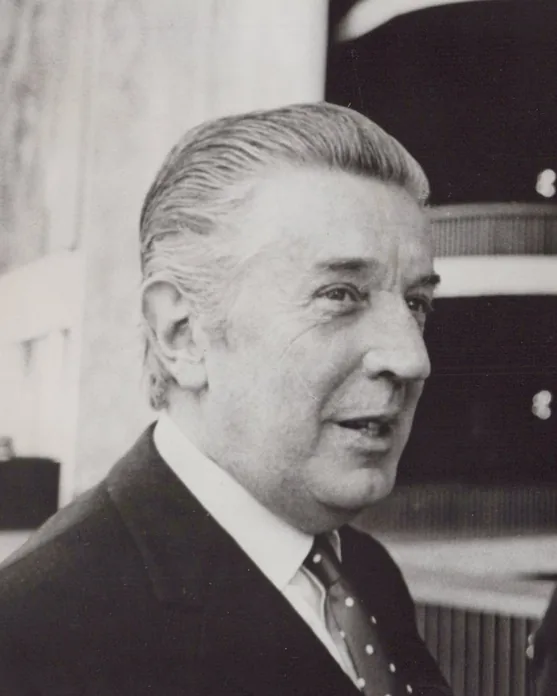
- Born
- 17 September 1904Guayaquil, Ecuador
- Died
- 18 August 1988Eye, United Kingdom · aged 83
Frederick Ashton
The founder of English ballet created “La fille mal gardée” and “Cinderella” – after seeing Anna Pavlova dance as a boy in Peru.
Frederick Ashton was born in Guayaquil, Ecuador, where his father worked for a cable company and the British consulate, and grew up in Ecuador and Lima, Peru. In 1917 he saw Anna Pavlova dance and knew immediately that he wanted to become a dancer. His conventional family was horrified. He was sent to school in England, where, as a gay boy with a foreign accent, he was miserable, and then to work in an office in the City of London.
After his father’s death in 1924 he began, at first in secret, to train as a dancer – unusually late, at twenty – with Léonide Massine and then with Marie Rambert. Rambert encouraged him to choreograph. In 1926 he created his first ballet; works such as “Façade” (1931) followed.
From 1935 he was chief choreographer of Ninette de Valois’ company, which became the Royal Ballet, and from 1963 to 1970 its director. Ashton is credited with creating a distinctly English style of ballet: lyrical, musical, witty and precise. Among his best-known works are “Symphonic Variations” (1946), “Cinderella” (1948), the first full-length English ballet, “La fille mal gardée” (1960), “The Dream” (1964), “Enigma Variations” (1968) and the film “The Tales of Beatrix Potter” (1971). He created many roles for Margot Fonteyn and later for Fonteyn and Rudolf Nureyev.
Ashton never hid his homosexuality from friends and colleagues. He was knighted in 1962. He died in 1988 in Eye, Suffolk, aged 83.