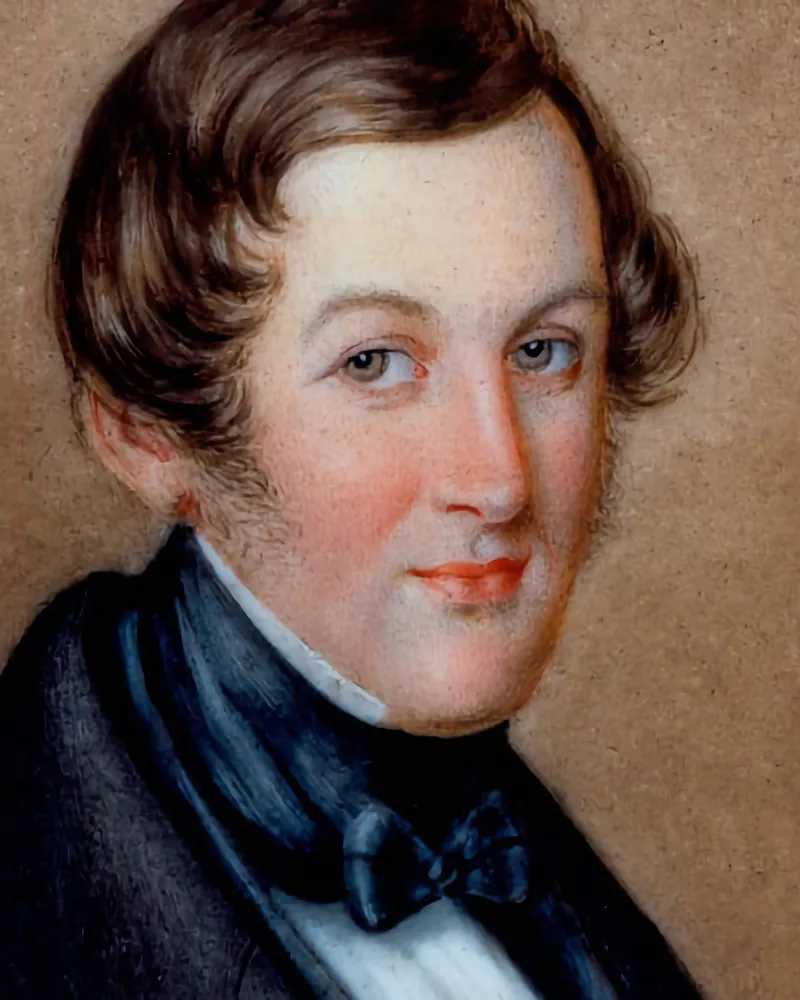
- Born
- 18 March 1790Niderviller, France
- Died
- 25 September 1857Paris, France · aged 67
Marquis de Custine
After a beating in 1824, Paris society shut him out without any law – yet he lived openly with his partner and wrote a classic about Russia.
Astolphe de Custine came from a noble family in Lorraine. His father and grandfather were guillotined during the French Revolution, and his mother only narrowly escaped the same fate. He grew up among intellectuals such as Madame de Staël and Chateaubriand, worked for a time as a diplomat and attended the Congress of Vienna.
In 1821 he married Léontine de Saint-Simon de Courtomer; they had a son. During the marriage Custine fell in love with the Englishman Edward Saint-Barbe, who moved into the house and remained his partner for the rest of his life. Léontine died young in 1823.
On the night of 28 October 1824 Custine was found unconscious in the mud outside Paris, stripped to the waist, beaten and robbed. He had reportedly arranged to meet a young soldier and was attacked by a group of soldiers. Since the Revolution, sex between men was no longer a crime in France, but the scandal made him an outcast in high society. His diplomatic career was over, and the police kept a file on him. Custine did not hide. He continued to live openly with Saint-Barbe, received artists such as Chopin at his country house and wrote novels and travel books.
His account “La Russie en 1839”, a sharp critique of the Tsar’s autocracy, became a bestseller in Europe and was banned in Russia. It is still regarded as a classic of travel writing. Custine died in Paris in 1857, aged 67.