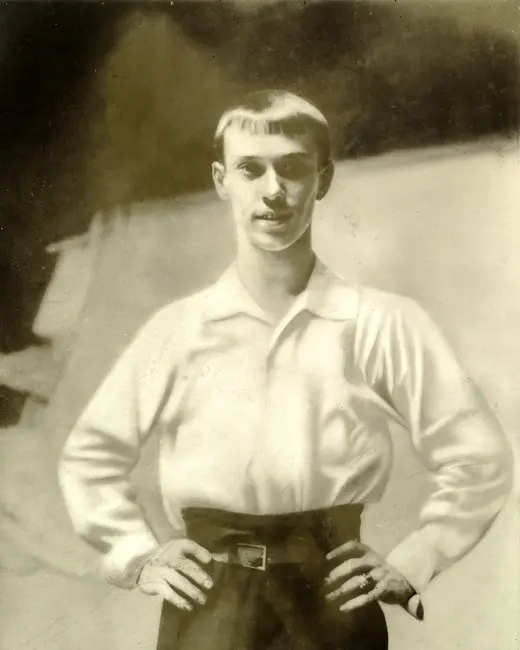
- Born
- 12 MarchKyiv, Ukraine
- Died
- 8 April 1950London, England
Vaslav Nijinsky
The greatest male dancer of his age was Diaghilev’s lover and star – until his marriage, and then his mind, ended his career.
Vaslav Nijinsky was born in Kyiv to Polish dancers, in 1889 or 1890 – the year is uncertain. He trained at the Imperial Ballet School in Saint Petersburg and became a soloist at the Mariinsky Theatre.
In 1908 he met the impresario Sergei Diaghilev, who became his lover and made him the star of the Ballets Russes. In Paris he amazed audiences with his seemingly weightless leaps and his androgynous, sensual presence, for example in “Le Spectre de la rose”. As a choreographer he created radically new works: “L’Après-midi d’un faune” (1912), whose erotic ending caused a scandal, and “The Rite of Spring” (1913), whose premiere ended in tumult.
In 1913, on a tour of South America without Diaghilev, he married the Hungarian dancer Romola de Pulszky. Diaghilev dismissed him. During the First World War Nijinsky was interned in Hungary. In 1919, in St. Moritz, he gave his last performance and wrote a diary that documents his descent into mental illness.
He was diagnosed with schizophrenia and spent most of the following thirty years in psychiatric clinics, including in Switzerland. He died in London in 1950. His story became a legend of genius and madness.