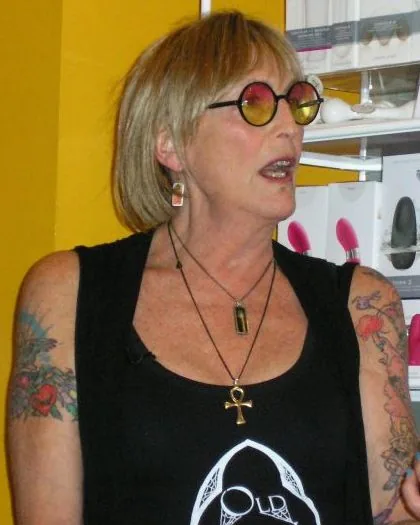
- Born
- 15 March 1948Asbury Park, New Jersey, USA
Kate Bornstein
Kate Bornstein mixes memoir, theatre and playful questioning to challenge fixed ideas of gender and help outsiders imagine lives they can bear to live.
Kate Bornstein was born in Asbury Park, New Jersey, in 1948. Raised in a Jewish family, she studied theatre at Brown University. Performance remained central to her later writing and activism: a way to experiment with identity, address an audience directly and question rules that are usually presented as natural or inevitable.
In 1970, Bornstein joined the Church of Scientology. She spent twelve years in the organisation, including service in its Sea Org, before leaving in 1982. Her memoir “A Queer and Pleasant Danger” later explored that experience, the costs of departure and the search for a life beyond the institution's demands. Her account connects questions of belonging and authority with her understanding of gender.
Bornstein transitioned during the 1980s and became involved in San Francisco's theatrical and lesbian communities. Plays and performances, including “Hidden: A Gender”, used the stage to challenge a division of human experience into two fixed and mutually exclusive categories. Rather than simply asking to move from one accepted box to another, she questioned who had drawn the boxes and what happened to people who could not remain inside them.
“Gender Outlaw”, published in 1994, brought memoir, cultural criticism and theatre into a form accessible beyond academic discussion. “My Gender Workbook” invited readers to examine their own assumptions rather than learn a final set of correct identities. Her collaborative novel “Nearly Roadkill”, written with Caitlin Sullivan, also experimented with gender, language and forms of communication.
Bornstein's work often proceeds through questions, jokes and apparent contradictions. That method is deliberate: certainty can become another way of excluding people. She has described herself as neither a man nor a woman and has long written about experiences now commonly discussed through the language of non-binary gender. Her vocabulary has developed over time, alongside the communities in which she works.
“Hello, Cruel World”, first published in 2006, addressed readers struggling to stay alive in a hostile world. Drawing on personal experience, it offered companionship and possibilities rather than a demand to become respectable before deserving care. Its attention to young people and outsiders extended her gender politics into a wider practice of survival and mutual support.
In 2018, at seventy, she made her Broadway debut in Young Jean Lee's “Straight White Men”. Her later work continues the combination of playfulness and serious concern that has characterised her career. For Bornstein, questioning gender has always also meant asking how people might gain enough room to live, create and form connections on their own terms.