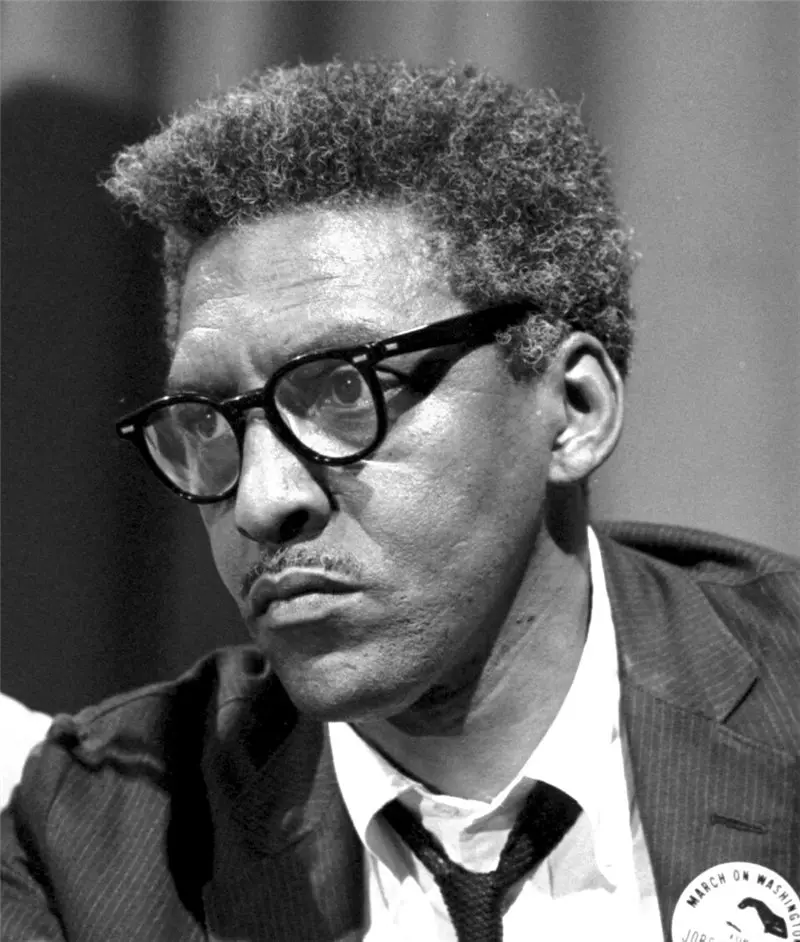
- Born
- 17 March 1912West Chester, Pennsylvania, USA
- Died
- 24 August 1987New York City, USA · aged 75
Bayard Rustin
He helped organise the March on Washington while opponents used his sexuality to undermine him and the civil rights movement.
Bayard Rustin was born in West Chester, Pennsylvania, in 1912. Raised by his grandparents in a household shaped by Quaker beliefs, he made non-violence a guiding principle of his political work.
During the Second World War he was imprisoned as a conscientious objector. In 1947 he joined the Journey of Reconciliation, an early challenge to segregation on interstate buses. He later advised Martin Luther King Jr. on non-violent resistance and helped turn those principles into practical organising.
Rustin was the chief organiser of the 1963 March on Washington for Jobs and Freedom, which brought around 250,000 people to the capital. His organisational skill was crucial, but opponents exploited his sexuality and a 1953 conviction arising from consensual sex with men. Even within the movement, concern about such attacks sometimes pushed him out of public view.
In later years Rustin spoke more directly for gay rights. He shared his life with Walter Naegle until his death in 1987. President Barack Obama awarded him the Presidential Medal of Freedom posthumously in 2013, and California pardoned his 1953 conviction in 2020, recognising the injustice of laws used to punish gay people.