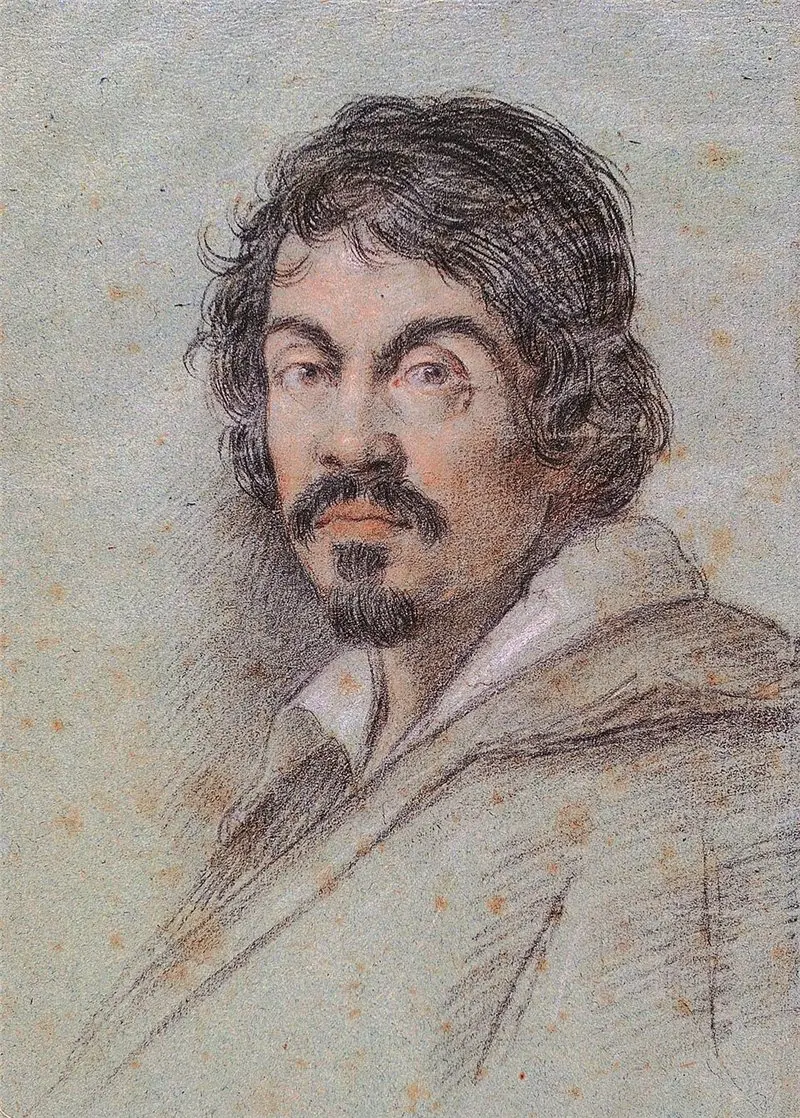
- Born
- 29 September 1571Milan, Italy
- Died
- 18 July 1610Porto Ercole, Italy · aged 38
Caravaggio
Caravaggio transformed religious painting through dramatic light and ordinary bodies. The sensual presence of young men in his early work also invites queer readings, while leaving the details of his private relationships uncertain.
Michelangelo Merisi, known as Caravaggio, was born in Milan in 1571. He trained in northern Italy before moving to Rome in the early 1590s. The name by which he became famous came from the town associated with his family, while the capital offered a demanding market for a young painter.
His early pictures gave unusual attention to people encountered at close range. Musicians, fortune-tellers and young men holding fruit could occupy the viewer's space with an immediacy that unsettled more polished conventions. Individual bodies, gestures and objects carried the painting's dramatic force.
Cardinal Francesco Maria del Monte became an important patron. “The Musicians”, associated with the cardinal's household, combines contemporary performance with an allegory of music. Cupid's presence connects the scene with love, while the models retain an earthy, recognisable physicality rather than dissolving into abstract symbols.
Works such as “Bacchus”, “Boy with a Basket of Fruit” and “Amor Vincit Omnia” likewise make the bodies of young men a focus of attention. Their sensuality has prompted sustained discussion of male desire. Such readings can illuminate the pictures without proving a complete history of the painter's intimate life.
Modern sexual identities cannot simply be inferred from a sitter, a commission or a painted scene. Patronage, artistic conventions and the work's intended setting also matter. The uncertainty is part of responsible interpretation, rather than a reason to ignore the homoerotic possibilities of the images.
His public religious commissions brought a wider audience. The paintings of Saint Matthew in Rome's Contarelli Chapel helped establish his reputation. Dramatic light and strongly observed figures made sacred events appear to unfold among people whose gestures and surroundings felt recognisably contemporary.
In “The Supper at Emmaus”, the moment of recognition is communicated through bodies reaching and reacting across the table. The composition draws viewers towards the event, making spectatorship an unusually physical experience. His influence spread through painters who adapted these methods in Italy and elsewhere in Europe.
Caravaggio's life was repeatedly disrupted by violence. After killing a man in Rome in 1606, he fled and worked in Naples, Malta and Sicily. The later paintings developed under circumstances of displacement and danger, but continued to attract important commissions.
He hoped to return to Rome with a pardon, but died at Porto Ercole on 18 July 1610, aged thirty-eight. The dramatic stories surrounding his life can overshadow the precision of his work. His lasting importance lies in paintings that make looking an encounter with bodies, light and emotion, while allowing unresolved questions about desire to remain visible.