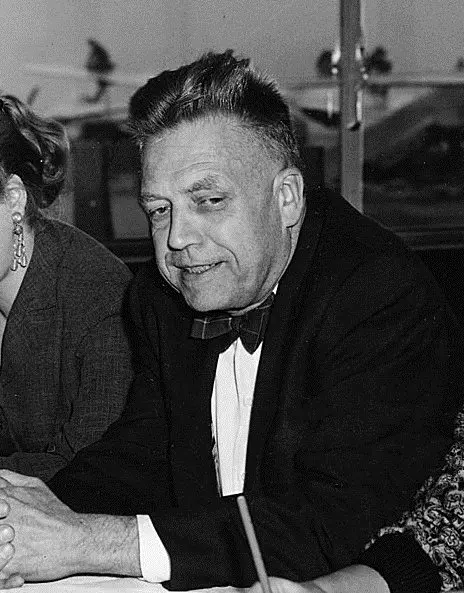
- Born
- 23 June 1894Hoboken, New Jersey, USA
- Died
- 25 August 1956Bloomington, Indiana, USA · aged 62
Alfred Kinsey
His interviews challenged America’s assumptions about sex and introduced the Kinsey scale of sexual orientation.
Alfred Charles Kinsey was born in Hoboken, New Jersey, in 1894. He began as a zoologist at Indiana University, spending years studying gall wasps. Teaching a marriage course in 1938 turned his attention towards the scarcity of reliable research on human sexual behaviour.
Kinsey and his colleagues collected thousands of detailed sexual histories. In 1947 he established the Institute for Sex Research. “Sexual Behavior in the Human Male” (1948) and “Sexual Behavior in the Human Female” (1953) reached a wide readership and provoked fierce debate about masturbation, premarital sex and same-sex experiences.
The reports introduced a scale running from 0, exclusively heterosexual, to 6, exclusively homosexual. It offered an alternative to treating those categories as entirely separate. Critics questioned the representativeness of his samples and aspects of his methods; the findings cannot simply be read as a statistical portrait of the whole population. Rockefeller support ended in 1954 amid mounting controversy.
Kinsey was married to Clara McMillen for more than three decades. Biographers also describe his sexual relationships with men, including colleagues, and the overlap between his private life and his research. He died in 1956, leaving a field of study that his work had helped bring into public discussion.