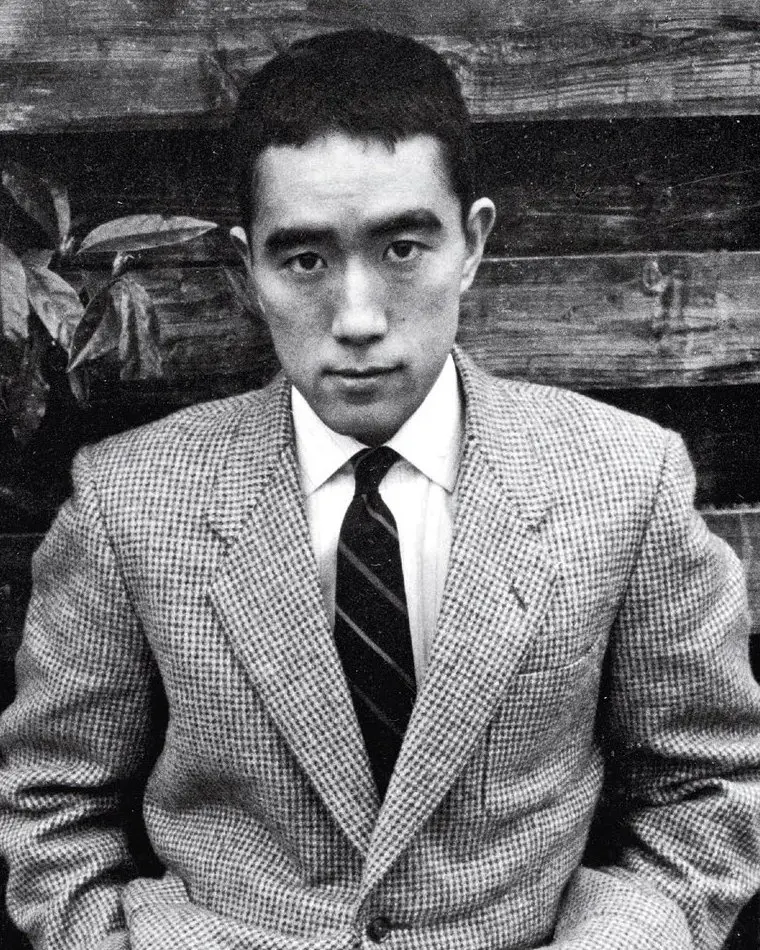
Yukio Mishima
One of Japan’s greatest writers described homosexual desire in “Confessions of a Mask” – and ended his life in a spectacular political act.
Yukio Mishima, born Kimitake Hiraoka, was raised in Tokyo largely by his grandmother, who kept him isolated from other children. A sickly boy, he read and wrote obsessively and published his first stories as a teenager.
His second novel, “Confessions of a Mask” (1949), made him famous. It tells of a young man who discovers that he desires men, not women, and hides behind a mask of normality. Novels such as “The Temple of the Golden Pavilion” (1956) and the tetralogy “The Sea of Fertility” followed. He was nominated for the Nobel Prize in Literature several times.
Mishima married in 1958 and had two children. Biographers and people who knew him have described relationships with men, and his own work returns again and again to desire between men, beauty, the body and death; how he himself understood his sexuality remains a subject of debate. From the 1950s he trained his body intensively and turned increasingly to nationalist and traditionalist ideas. He founded a small private militia.
On 25 November 1970 he and members of his group occupied the office of a general of the Japanese Self-Defence Forces in Tokyo and called for a coup. When the soldiers mocked him, he took his own life in a ritual act. He was 45 years old.