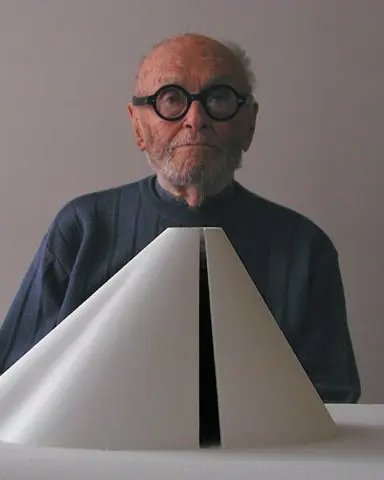
- Born
- 8 July 1906Cleveland, Ohio, USA
- Died
- 25 January 2005New Canaan, Connecticut, USA · aged 98
Philip Johnson
The architect of the Glass House shaped modern architecture for seventy years – a career with a dark chapter in the 1930s.
Philip Johnson came from a wealthy family in Ohio and studied at Harvard. In 1930 he became the first director of the architecture department of the Museum of Modern Art in New York. In 1932, together with Henry-Russell Hitchcock, he organised the exhibition that introduced the term “International Style” and made modern European architecture known in America.
In the 1930s he left the museum and turned to far-right politics: he admired Hitler, wrote for an antisemitic magazine and travelled to Germany. He later called this the “stupidest thing” he had ever done and apologised. Historians count it as a dark chapter of his life.
After studying architecture he built the Glass House in New Canaan, Connecticut (1949), a transparent pavilion that became an icon of modernism. Together with Mies van der Rohe he designed the Seagram Building in New York, and later, with the AT&T Building, became a leading figure of postmodernism. In 1979 he was the first architect to receive the Pritzker Prize.
Johnson was gay and lived for 45 years with the curator David Whitney. He spoke openly about it only late in life. He died at the Glass House in 2005, aged 98.