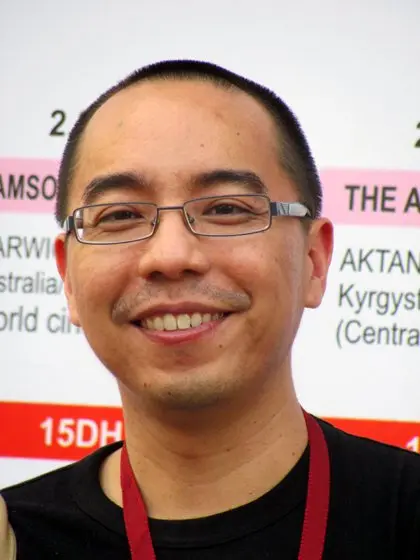
Apichatpong Weerasethakul
His films bring queer desire, memory and spirits into a cinema that moves between everyday life and dreams.
Apichatpong Weerasethakul was born in Bangkok in 1970. He grew up in Khon Kaen in north-eastern Thailand, where his parents were doctors. After studying architecture there, he studied film at the School of the Art Institute of Chicago and began making experimental work in the 1990s.
His films move between everyday observation, memory, dreams and local stories. In “Tropical Malady” (2004), a relationship between two men gives way to a mysterious encounter in the jungle. It won the Jury Prize at Cannes. “Uncle Boonmee Who Can Recall His Past Lives” received the Palme d’Or in 2010, the first Thai film to win the award.
“Memoria” (2021), made in Colombia with Tilda Swinton, extended his exploration of sound, landscape and uncertain perception. It also won a Jury Prize at Cannes.
Openly gay, Apichatpong has made queer desire part of his work without reducing his characters to statements about identity. He has also spoken against censorship and military rule in Thailand. Alongside his feature films, he makes short films and installations for galleries and museums, allowing images and stories to take forms beyond conventional cinema.