- Born
- 20 November 1910Baltimore, Maryland, USA
- Died
- 1 July 1985Pittsburgh, USA · aged 74
Pauli Murray
A civil rights lawyer whose ideas shaped both Brown v. Board of Education and women’s rights law – and who struggled all their life with gender.
Pauli Murray lost both parents as a child and grew up in Durham, North Carolina, with an aunt. Murray studied in New York and in 1940, fifteen years before Rosa Parks, was arrested for refusing to move to the back of a segregated bus in Virginia. Murray then studied law at Howard University and graduated first in the class – but was refused admission to Harvard because Harvard did not accept women.
Murray coined the term “Jane Crow” for the double discrimination faced by Black women. Murray’s book “States’ Laws on Race and Color” (1951) was called the “bible” of the civil rights movement by Thurgood Marshall. Murray co-founded the National Organization for Women in 1966, and Ruth Bader Ginsburg later named Murray as a co-author of a landmark brief on sex discrimination because her arguments built on Murray’s work.
Murray had relationships with women and from a young age described themself as a “he/she personality”; in the 1930s and 1940s Murray sought, in vain, hormone treatment from doctors. Today many people read Murray’s life as that of a trans or non-binary person; Murray used “she” during their lifetime.
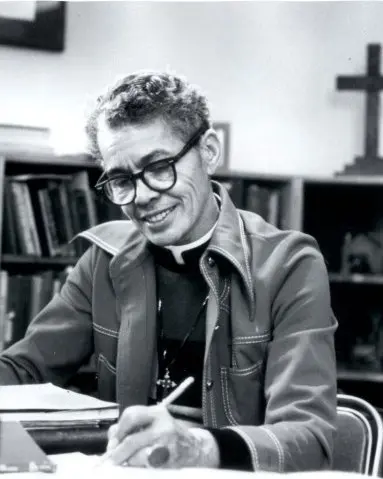
In 1977 Murray became the first Black woman to be ordained as an Episcopal priest. Murray died in Pittsburgh in 1985, aged 74.