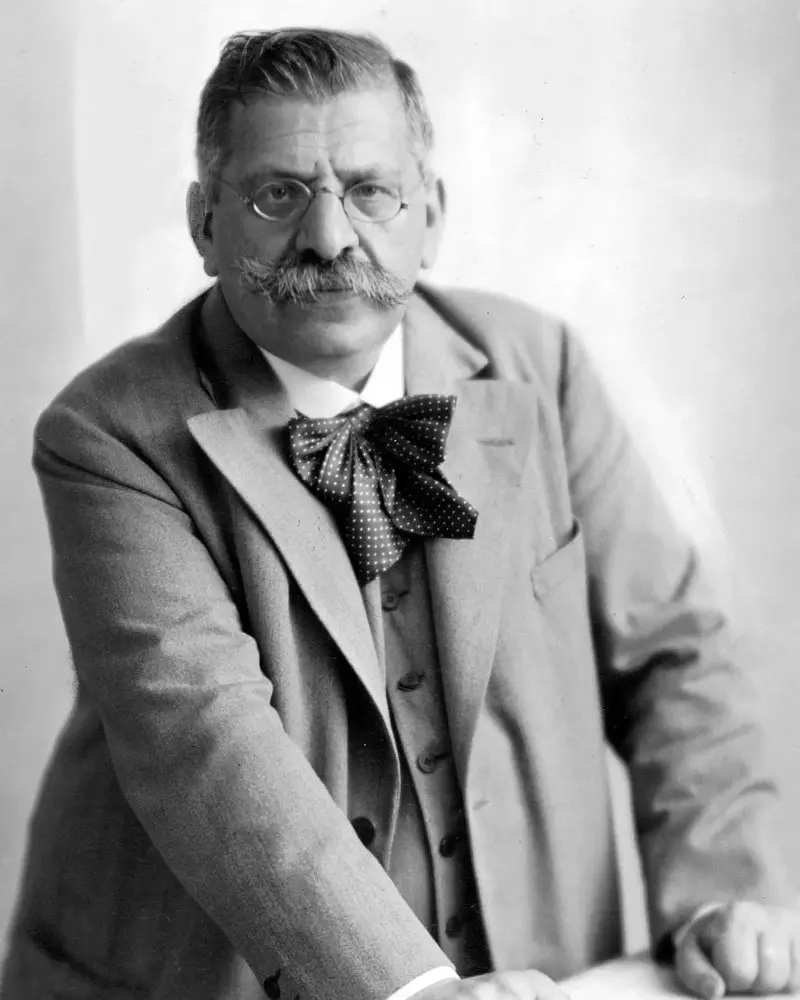
- Born
- 14 May 1868Kolberg, Prussia (today Kołobrzeg, Poland)
- Died
- 14 May 1935Nice, France · aged 67
Magnus Hirschfeld
He founded the world’s first gay rights organisation and the first institute for sexual science – which the Nazis destroyed in 1933.
Magnus Hirschfeld was born into a Jewish doctor’s family in Pomerania and became a physician in Berlin. Moved by the suicide of a young gay patient, he devoted his life to the scientific study of sexuality and to the rights of sexual minorities.
In 1897 he founded the Scientific-Humanitarian Committee, the world’s first organisation to campaign for the rights of gay people. It launched a petition against Paragraph 175, the German law against sex between men, which was signed by Albert Einstein, Thomas Mann and many others. Hirschfeld described homosexual and trans people as natural variations of human sexuality, a “third sex”.
In 1919 he opened the Institute for Sexual Science in Berlin, a clinic, research centre and archive. It was here that some of the first gender-affirming surgeries were carried out. In the same year he co-wrote and appeared in “Different from the Others”, one of the first films to portray gay men sympathetically. As a Jewish, gay and left-wing man he was a target of the far right; in 1920 he was badly beaten in Munich.
On 6 May 1933 Nazi students plundered his institute; its books were burned a few days later. Hirschfeld, who was abroad on a lecture tour, never returned. He died in exile in Nice in 1935, on his 67th birthday. His partners Karl Giese and, in his last years, Li Shiu Tong had accompanied his work.