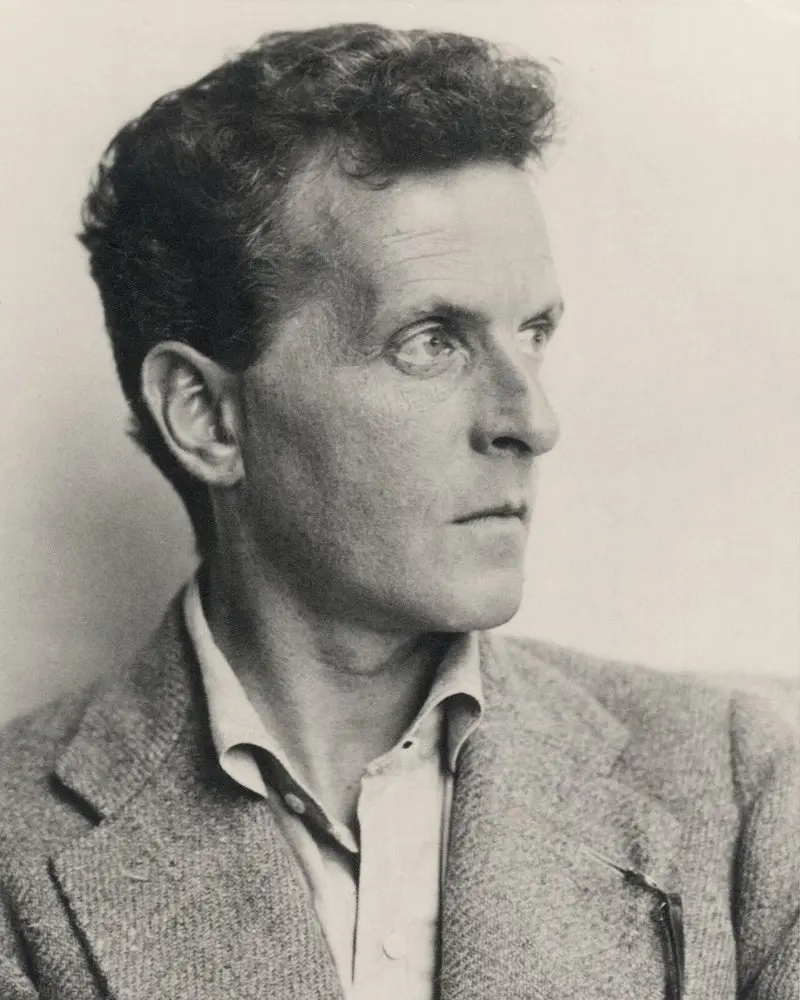
- Born
- 26 April 1889Vienna, Austria
- Died
- 29 April 1951Cambridge, England · aged 62
Ludwig Wittgenstein
One of the most important philosophers of the 20th century gave away his fortune – and loved a series of young men, as his coded diaries reveal.
Ludwig Wittgenstein was born into one of the richest families in Europe; music and art filled the family palace in Vienna, but three of his brothers took their own lives. He studied engineering, then went to Cambridge in 1911 to study logic with Bertrand Russell. There he became close friends with the young mathematician David Pinsent, whom many biographers describe as his first love.
In the First World War he served as a soldier in the Austro-Hungarian army and wrote the “Tractatus Logico-Philosophicus” (1921), in which he believed he had solved the problems of philosophy. He gave away his inheritance and worked for years as a village schoolteacher in Austria, then as a gardener and architect.
In 1929 he returned to Cambridge, where he developed a completely new philosophy of language, published after his death as “Philosophical Investigations”. In the 1930s he had a close relationship with his student Francis Skinner, and later with the young doctor Ben Richards. His diaries, partly written in code, show how much he struggled with his feelings and his sexuality.
He died in Cambridge in 1951, aged 62. His last words are said to have been: “Tell them I’ve had a wonderful life.”